
Decide what the pilot is supposed to tell you
A provider can ship a small trial accurately and still be untested on the work that matters most to your brand. If the trial contains only easy, single-item orders, its result says little about a retailer-specific label or a gift message changed before release. The selection decision should depend on both ordinary execution and coverage of consequential exceptions.
Start by writing two questions: can the provider handle the normal order mix, and can it execute each essential special workflow? These questions need different samples. Combining them into one headline accuracy percentage hides what was never exercised.
What a small random sample can miss
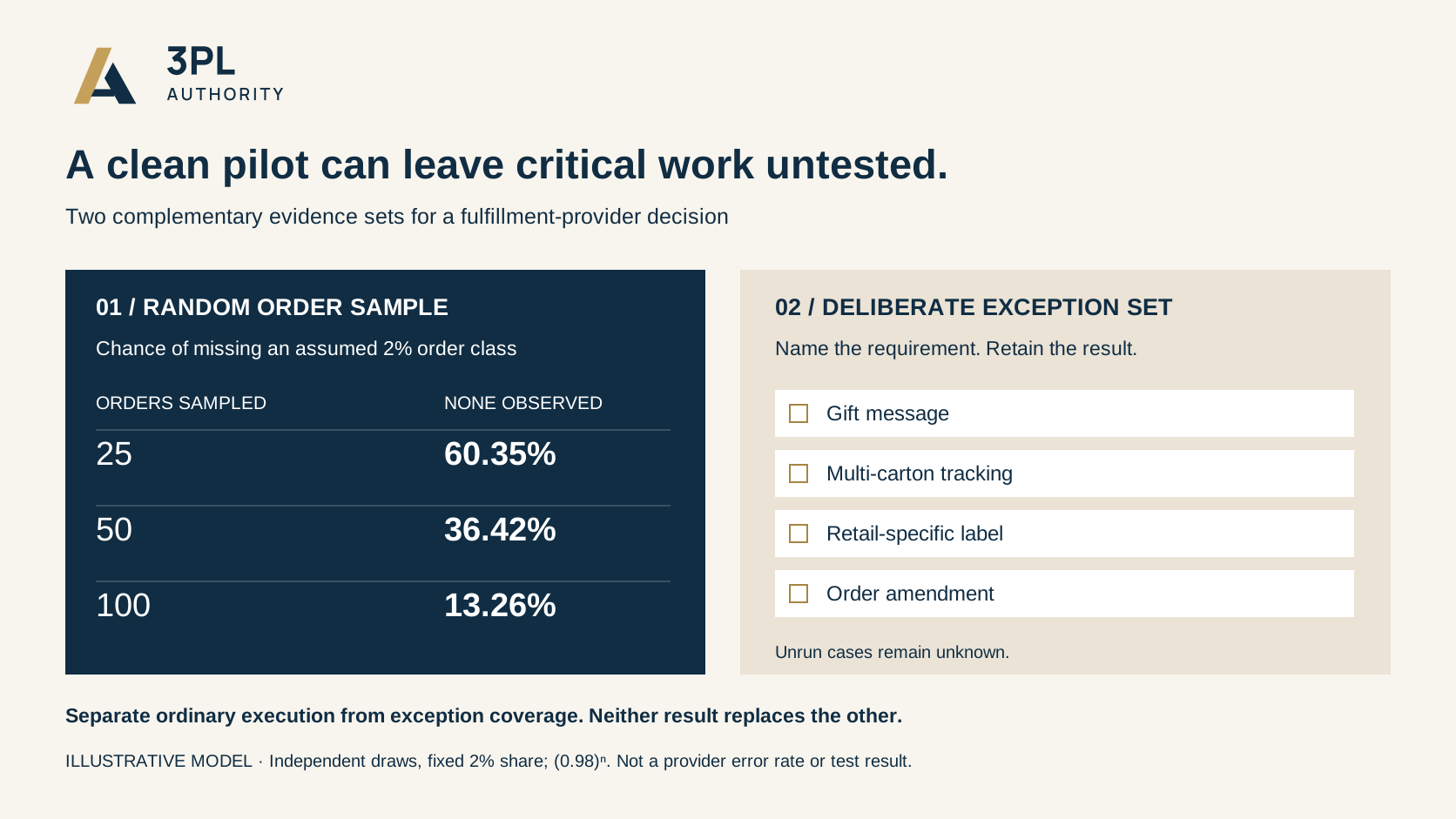
We calculated three illustrative cases using an assumed order class that represents 2% of orders. Under independent sampling with an unchanged class share, the probability of seeing none of those orders is (1 − 0.02) raised to the sample size. This follows the zero-occurrence case of the NIST binomial model.
| Randomly selected orders | Chance of missing the assumed 2% class |
|---|---|
| 25 | 60.35% |
| 50 | 36.42% |
| 100 | 13.26% |
These are calculations, not observed provider results. They estimate missing an order type, not the probability of a fulfillment error. Real orders can cluster by promotion or customer, so independence may be a poor approximation. The lesson is narrower: a clean small sample is compatible with no exposure to a rare requirement.
Add a deliberate exception set
Build a second list from your own operational requirements. For each essential case, specify the input, expected output and evidence to retain. A gift order might require an approved note; a multi-carton order might require separate tracking identifiers; a retail shipment might require a particular label; an amendment might need an explicit release decision.
Use approved test orders and agree with the provider how they will be isolated from real customer shipments. Do not create a deliberately dangerous or noncompliant shipment to test a boundary. Where physical execution is inappropriate, request a documented walkthrough and label that evidence accordingly.
A four-row coverage sheet is more useful than a vague promise of flexibility. Record whether each case was demonstrated, whether the result matched the requirement, what failed, and whether a corrected retest occurred. An unrun case remains unknown.
Keep the two results separate
Report ordinary-sample results with their order count and selection method. Report exception coverage as named workflows, not as an estimate of population-wide accuracy. Deliberately oversampling complicated orders is useful for finding process gaps, but it changes the mix and cannot support a like-for-like error-rate comparison with normal production.
Before committing more stock, resolve failures in essential workflows or explicitly restrict the launch scope. A provider may be suitable for standard DTC orders while an unproven retail process stays outside the initial agreement. That is a more defensible decision than treating a small successful pilot as permission to send everything.
Related reading
Sources
- https://www.itl.nist.gov/div898/handbook/eda/section3/eda366i.htm — accessed 2026-10-25