
Price is not the only constraint on dispatch
A fulfillment quote can look affordable while requiring more cash in advance than the brand has planned. If the arrangement uses a prepaid shipping balance, dispatch depends on two flows: orders reaching the warehouse and money becoming available to buy their labels. A payment initiated by finance is not necessarily usable funding in the shipping system.
The Small Business Administration’s business-finance guidance distinguishes transaction timing from cash receipt and encourages examining money entering and leaving the business. For a 3PL selection, turn that principle into a dated funding exercise. The exercise below models a fictional arrangement, not the practices or financial condition of any named provider.
Model the balance at the moment a top-up starts
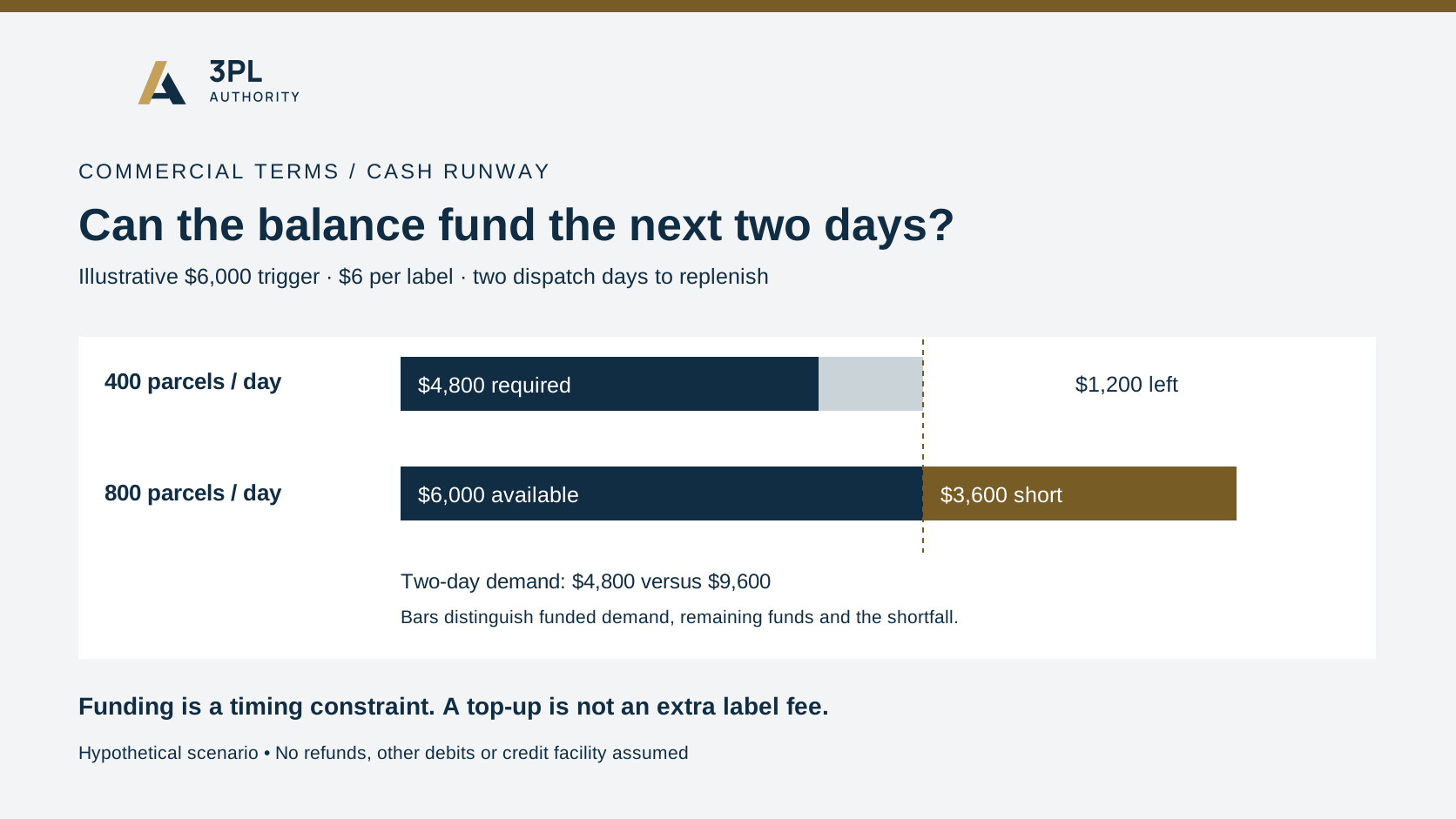
Assume a provider starts replenishment when available funds reach $6,000. The brand expects 400 parcels per dispatch day at an illustrative average label debit of $6. A top-up takes two full dispatch days to become usable. Assume no other debits, refunds or credit facility during that interval.
Daily demand consumes $2,400. The trigger balance therefore covers 2.5 dispatch days. After two days, $1,200 remains. That is a narrow operating cushion, even though the modeled top-up arrives before exhaustion.
Now double daily parcels to 800 without changing the average debit or the funding delay. Consumption becomes $4,800 a day, and the same trigger covers only 1.25 days. The two-day requirement is $9,600: $3,600 more than the trigger balance. The cheaper rate has not changed, but the funding arrangement no longer supports the assumed workload.
| Illustrative workload | Spend per dispatch day | Two-day requirement | $6,000 balance after requirement |
|---|---|---|---|
| 400 parcels | $2,400 | $4,800 | $1,200 remaining |
| 800 parcels | $4,800 | $9,600 | $3,600 short |
We calculated two scenarios from the same trigger, debit and delay to isolate volume. These are assumed daily averages, not a forecast or observed failure rate. Intraday surges, adjustment debits and funding cutoffs could change the result.
Separate funding from expense
A $10,000 top-up is not automatically $10,000 of additional shipping expense. It may fund labels already included in the shipping forecast. Counting both the top-up and those labels as separate costs would exaggerate the operating bill. At the same time, cash committed to the balance may not be available for payroll or purchasing stock. Ask your finance team how the actual arrangement should be recorded.
Request a daily view with opening usable balance, new funding that has cleared, label debits, adjustments, credits and closing usable balance. Keep pending funding in a separate column. This makes a temporary cash requirement visible without pretending it is a new fee.
Negotiate the interruption rules before peak
Ask each shortlisted provider what happens at a low balance: an alert, a restricted service selection, an order hold or an agreed credit arrangement. Confirm who receives the alert and who can authorize funding outside normal office hours. Request the actual holiday and weekend clearing assumptions for the selected payment method.
Agree how unused funds are returned on exit, how disputed debits affect usable funds and whether multiple warehouses share one balance. Do not assume an automated top-up eliminates settlement delays. A proposed safety threshold should reflect verified timing and a demand scenario your team can support.
The selection decision is whether the commercial workflow fits your available cash and dispatch promise. Require a worked balance trace from the provider, then rerun it at your busiest plausible volume. A rate comparison becomes much more useful when the funding needed to use that rate is visible.
Further reading
Sources
- https://www.sba.gov/counseling/manage-your-business/ — accessed 2026-10-30.