
A good alternative needs time to become real A lower quote is not yet an executable switch. Your team still needs an agreed inventory transfer, working order flow, a receiving slot and a person empowered to accept the new operation. Leaving those questions until a notice deadline turns an evaluation into an emergency.
Start by having the person responsible for the agreement confirm the actual notice date, required delivery method, recipient and renewal consequences. Do not derive those from an invoice date or an account manager's recollection. Contract terms differ; this planning framework does not interpret yours.
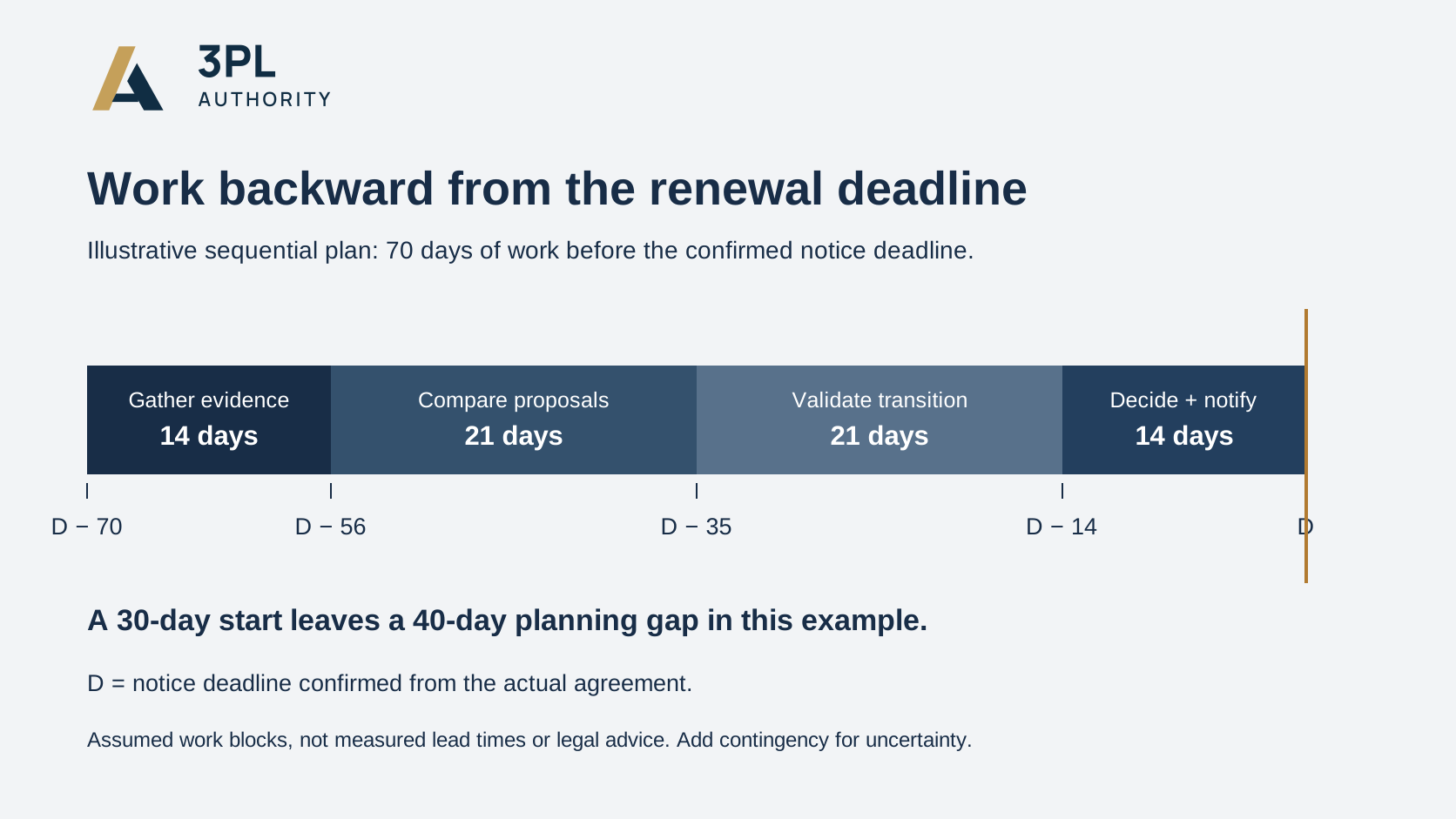
Build the decision calendar backward Our desk exercise uses four hypothetical sequential work blocks. These are planning assumptions, not measured industry lead times. Let D be a notice deadline already confirmed from the agreement.
| Work block | Illustrative allocation | Latest finish |
|---|---|---|
| Collect invoices, incidents and operating requirements | 14 days | D minus 56 days |
| Obtain comparable renewal and alternative proposals | 21 days | D minus 35 days |
| Validate transition dependencies and unresolved quote items | 21 days | D minus 14 days |
| Obtain internal decision and complete required notice process | 14 days | D |
The blocks total 70 days. A team starting 30 days before D has a 40-day planning shortfall under these assumptions. That is a reason to investigate workable options early, not evidence that any particular move can be compressed. Add contingency where a dependency is uncertain; parallelize only work that genuinely can proceed independently.
Separate the recurring saving from the cost of moving The SBA distinguishes fixed, variable and mixed costs in its cost-analysis guidance. Apply that discipline to the comparison: recurring savings and one-time transition spending belong on separate lines.
In a second, explicitly illustrative calculation, assume a switch costs $18,000 and reduces like-for-like monthly spending by $2,000 after stabilization. Simple payback is nine months. Across 12 full months of savings, the net benefit is $6,000. If the saving is only $1,000 per month, payback becomes 18 months and the same 12-month result is negative $6,000. These figures exclude financing, tax, service differences and lost sales; they are a sensitivity exercise, not a forecast or provider quote.
Include overlap storage, transfer freight, setup, integration work and internal labor in your own transition estimate. Avoid counting an unchanged expense as a saving. Equally, do not bury a persistent service problem merely because its remedy takes effort.
Make renewal an explicit operating choice Prepare a one-page decision with three possible outcomes: renew on acceptable terms, proceed with a validated alternative, or seek a documented interim arrangement where available. An interim arrangement is a negotiation request, not an assumed contractual right.
Attach an owner and evidence date to each unresolved item. Ask the incumbent what will change, how the change will be measured and when it will be reviewed. Ask the alternative to demonstrate the difficult order and transfer scenarios rather than promising a painless migration.
The useful decision is the one your team can execute before its real deadline. A compelling spreadsheet with no ready receiving plan is still an unfinished alternative.
Further reading
Sources
- Source 1 — accessed 2026-10-28.