
Start with the work that stays on your desk
A fulfillment proposal can remove picking and packing while leaving your team with replenishment decisions, product-data repairs and exception approvals. That can still be a good trade. The selection problem is whether your remaining team has enough time and authority to do its part.
Ask each shortlisted provider to walk through a normal week from your side of the relationship. Who prepares inbound information? Who resolves an unclear product identifier? Who approves an unusual return? A dashboard that displays a problem does not tell you who will finish the work.
Separate execution from decision support
Shopify documents that merchants can use a fulfillment service, fulfill orders themselves, or combine methods. It also distinguishes app-connected services from custom services that receive orders by email. That is a useful reminder to examine the actual operating arrangement rather than assume that every integration removes the same work. Shopify fulfillment overview.
For your evaluation, divide responsibilities into three columns: provider completes, brand decides, and someone must investigate before either can proceed. The third column deserves particular attention. A request for approval may arrive without the facts needed to make the decision. Preparing those facts is work too.
Put minutes against a plausible week
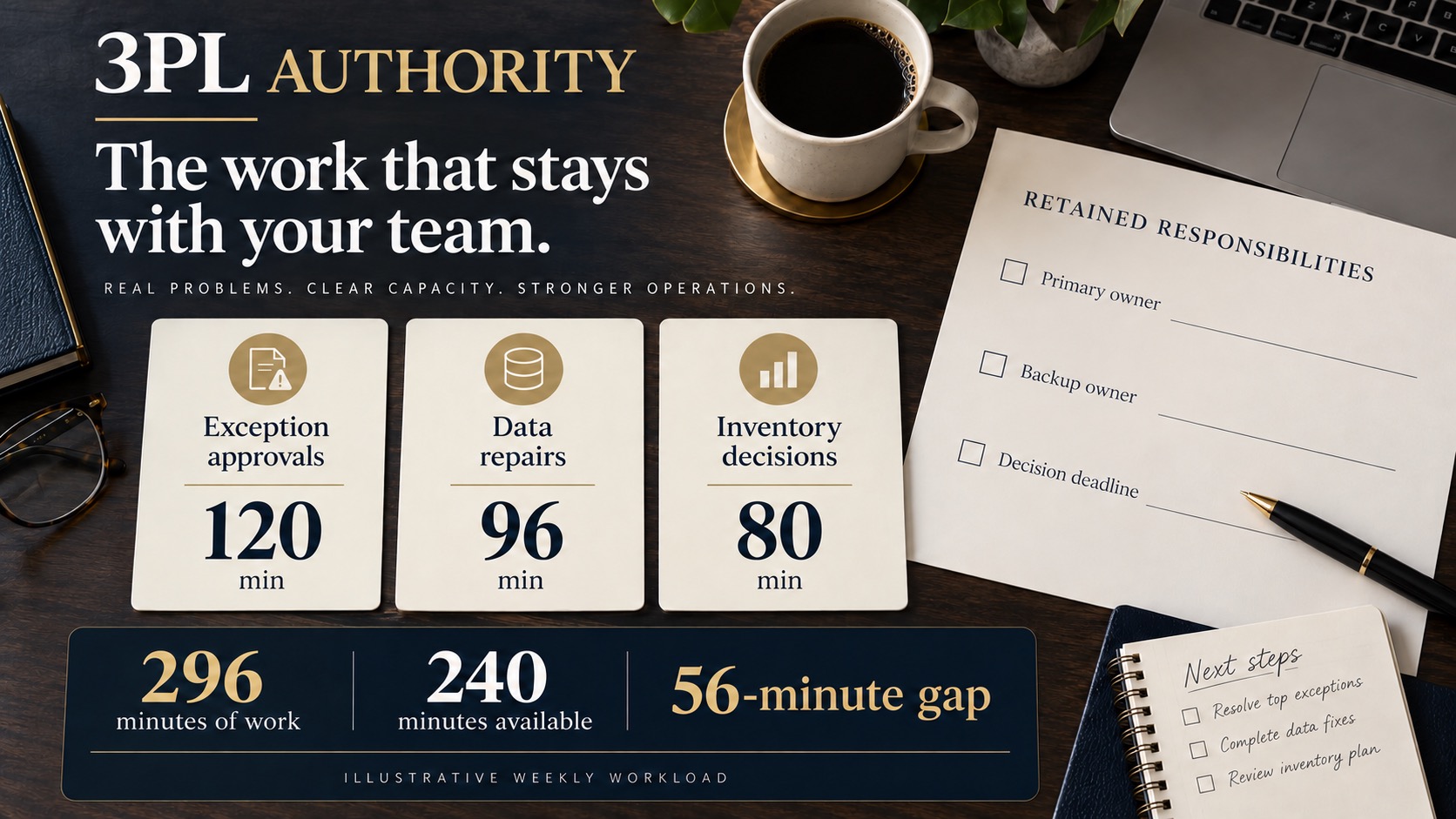
We calculated one illustrative weekly workload using three invented task categories. These are planning assumptions, not observed provider performance or staffing benchmarks.
| Retained task | Weekly events | Active minutes each | Weekly minutes |
|---|---|---|---|
| Exception approval | 20 | 6 | 120 |
| Product or order data repair | 8 | 12 | 96 |
| Inventory analysis and decision | 4 | 20 | 80 |
| Total | 296 |
That is four hours and 56 minutes. If the brand allocates four hours, the assumed recurring work already exceeds capacity by 56 minutes. The calculation excludes meetings, context switching and urgent interruptions. It also says nothing about how quickly the provider responds.
The useful conclusion is narrow: this particular operating design does not fit that particular time budget. It is not evidence that a small team cannot outsource successfully.
Test a service promise against the workload
Suppose a provider offers proactive exception management. Ask which of the three rows it would reduce and what evidence the brand receives before approving an action. Then revise the event count or handling time only when the proposed scope supports the change. Do not simply subtract a promised percentage from the total.
Compare a routine week with a promotion week separately. A weekly total can hide a difficult concentration of decisions on one afternoon. Record both active handling time and the deadline by which the brand must respond to keep orders moving.
Make the responsibility map part of selection
Before choosing, identify a primary and backup owner for every retained task, specify the information they need, and agree on what happens if nobody responds. Where the proposal leaves a responsibility unclear, mark it unresolved rather than assigning zero minutes.
A more expensive service may be worthwhile if it removes work that your team cannot reliably perform. A simpler service may fit a brand with strong internal operations. Choose on the combined operating model: warehouse capability plus the workload your own people can sustain.
Related reading
Sources
- https://help.shopify.com/en/manual/fulfillment/fulfilling-orders — accessed 2026-10-23