
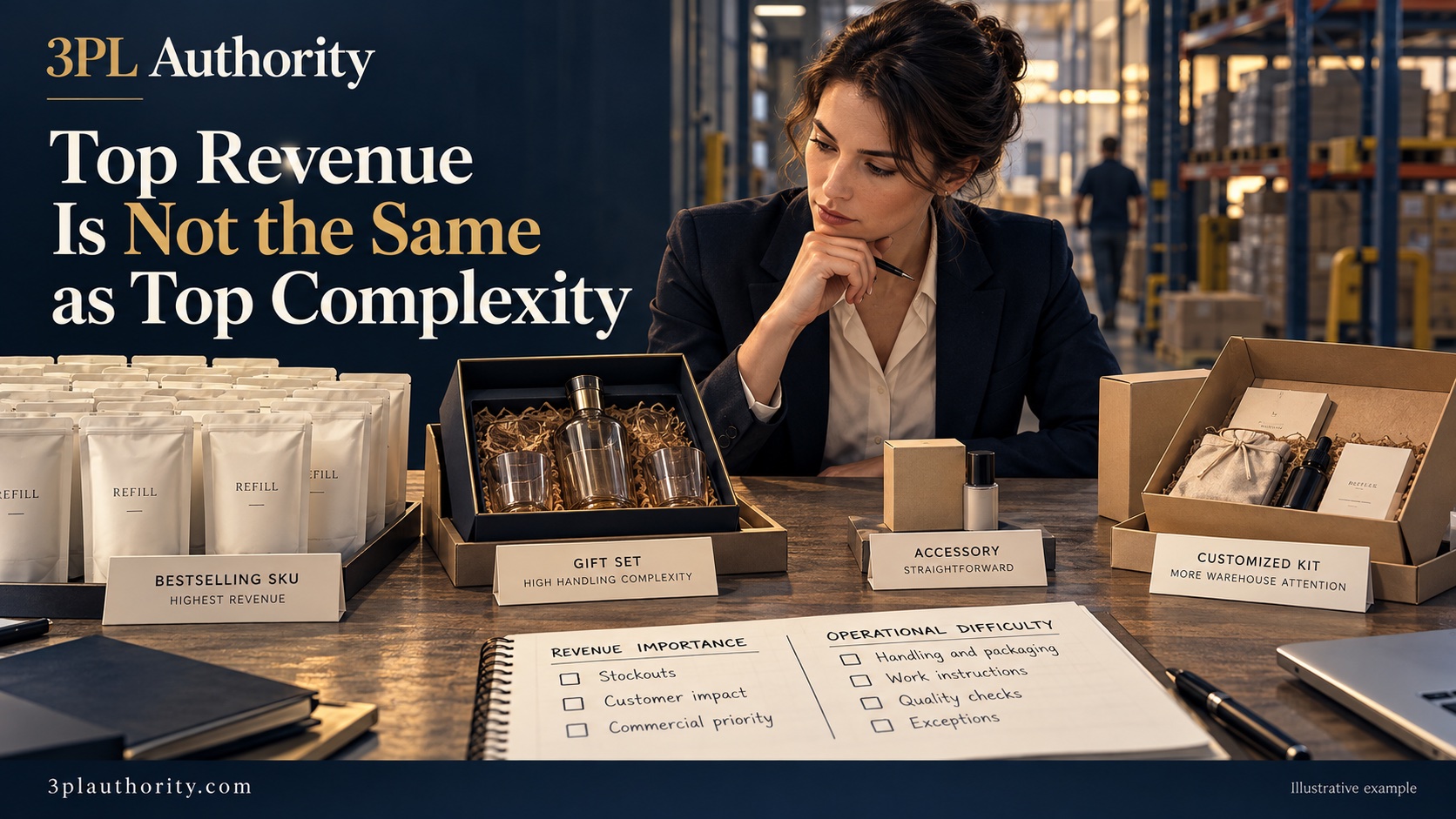
A provider can understand your order count and still misunderstand your business. The products that carry the most revenue are not necessarily the products that consume the most warehouse attention. A selection process needs both views.
Shopify's ABC analysis groups products by revenue contribution, and its documentation explicitly excludes item cost from the grade calculation. That makes the grade useful for setting commercial priorities, but it does not establish margin or fulfillment difficulty. Shopify ABC analysis.
Give the same catalog two rankings
We constructed a four-product example to see whether revenue ranking and handling ranking could produce different priorities. All numbers below are illustrative assumptions, not measured warehouse results. Each unit is assumed to require its own handling task; there are no shared picks or batch efficiencies.
| Product | Units | Revenue per unit | Handling minutes per unit | Total revenue | Total handling minutes |
|---|---|---|---|---|---|
| Compact refill | 800 | $20 | 1 | $16,000 | 800 |
| Glass gift set | 100 | $80 | 8 | $8,000 | 800 |
| Accessory | 200 | $10 | 1 | $2,000 | 200 |
| Customized kit | 50 | $60 | 12 | $3,000 | 600 |
The refill leads revenue, while the gift set ties it for handling time on one-eighth as many units. The kit generates less revenue than either but still consumes one-quarter of the modeled 2,400 handling minutes. This does not make the kit unprofitable: labor cost, margin, returns and customer value are absent from the model.
It does show why a single priority list is incomplete. Revenue suggests where a stockout could matter most. Handling estimates suggest where training, packaging and process design deserve investigation.
Turn the difference into selection questions
Ask each shortlisted 3PL to explain how it would handle the gift set and kit before asking for a blended pick rate. Request the proposed packing method, work instructions, quality check and exception owner. Treat the response as a proposal until demonstrated with your products.
For the refill, examine replenishment and inventory accuracy. For the kit, examine how instructions reach the operator and how missing components stop work. These are different demonstrations, even if both products ship in a carton.
Do not turn the illustrative minutes into a contractual productivity target. Replace them with observations from an agreed pilot, including the task definition, batch size and work excluded from timing. Otherwise a fast result may simply omit preparation or cleanup.
Decide what deserves a separate promise
Build a selection sheet with one commercial concern and one operating concern per important product family. Give each concern an evidence request and a decision owner. An unknown should stay unknown until the provider supplies a usable answer.
A strong fit is a provider whose proposed controls address the work your assortment creates. It is not necessarily the provider that makes the most confident claim about average orders per day. Use the two rankings to decide where to look closely, then let the evidence determine the shortlist.
Related reading
Sources
Accessed September 30, 2026. Recheck time-sensitive terms before publication.
- https://help.shopify.com/en/manual/products/inventory/adjusting-inventory/abc-analysis