
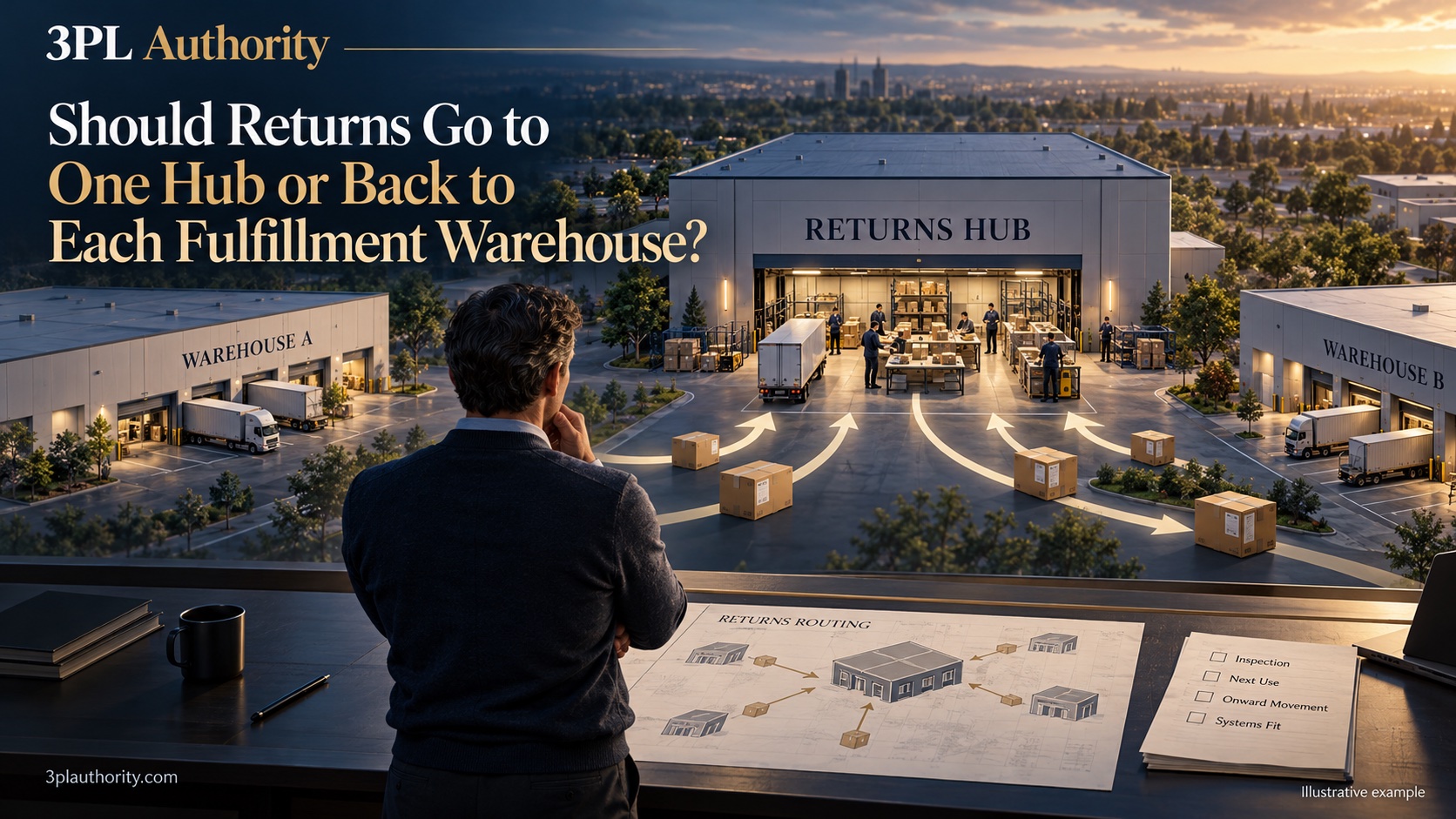
The outbound network and the returns network do not have to be identical. A brand shipping from two warehouses might process every return in one place, or return stock to the warehouse best placed to sell it again. The strategic question is where inspection and recovery create enough value to justify the route.
Start with the next use of the goods. A return destined for repair has a different path from an unopened unit needed for an imminent order. Comparing return-label prices alone stops the analysis too early.
Check that the routing can be implemented
Shopify’s return-label workflow allows a return address to be selected from saved locations and provides a default return-location setting. That supports a routing choice in that workflow; it does not demonstrate that every returns app or 3PL integration uses the same setting. Shopify return labels.
Ask who controls the address used on each label and how exceptions are handled. Test your actual systems before announcing a new return destination. A strategy that lives only in a spreadsheet will not redirect parcels already labeled for the old location.
Compare the whole recovery journey
Original illustrative scenario: 500 returns arrive in a month. Both models incur the same customer-to-return-location transport cost, which is excluded here. Local processing costs an invented $5 per return. A central hub costs $3 per return, but 300 recovered units need an onward transfer at an assumed allocated cost of $2 each.
| Modeled component | Local processing | Central hub |
|---|---|---|
| Inspection of 500 returns | $2,500 | $1,500 |
| Onward movement | $0 | $600 |
| Modeled total | $2,500 | $2,100 |
The central model saves $400 in this constructed case, not the $1,000 suggested by inspection alone. If the onward allocation rises to $4 per unit, its total becomes $2,700 and the ranking reverses. The crossover for those 300 units is approximately $3.33 each.
These are not market rates or measured provider outcomes. Actual inbound transport differences, fixed fees, storage and recovery yields must also be included.
Treat time as a separate decision
Ask for the interval from receipt to disposition, then from disposition to usable inventory at the required location. A unit can be graded as sellable but remain far from the next customer order.
Do not convert a few extra days into invented lost sales. Use your own stockout exposure or keep the timing tradeoff explicit. Some products can wait for a consolidated transfer; others may need prompt local recovery.
Choose by product group
A single rule may not fit the whole catalog. Our editorial framework separates ordinary resellable returns, items requiring specialist work and goods awaiting a brand decision. Ask candidates which groups they can process, where and with what evidence.
A central hub is strongest as a proposal when it identifies the specific work being consolidated and the next destination of recovered stock. Local processing is strongest when it preserves useful inventory position without sacrificing the required inspection. Compare those operating cases before choosing the map.
Related reading
Sources
- Shopify documents return-address selection from saved locations — accessed 2026-10-09.