
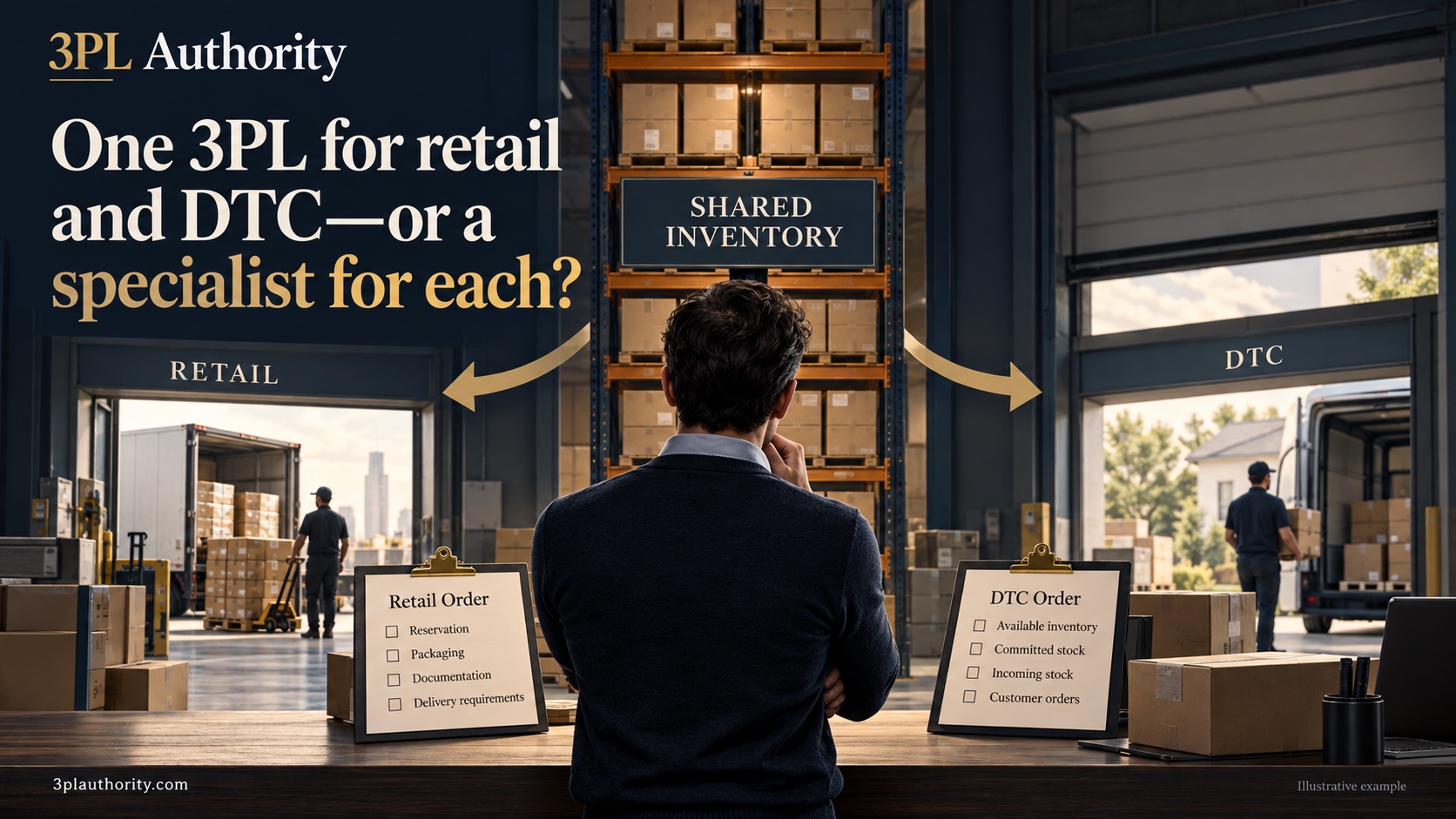
Adding a retailer creates a new fulfillment decision: expand the current 3PL relationship or hire a specialist. Both can be sensible. The mistake is deciding from a list of supported channels before working through what happens when two customers want the same stock.
One provider can simplify the physical inventory pool. Two providers can create a clearer operational focus. Neither structure, by itself, settles which orders receive scarce inventory or who pays to move it when the forecast changes.
Separate capability from allocation
Ask each candidate to price and demonstrate your actual retail order and your ordinary direct-to-consumer order. Retail readiness may involve customer-specific documents, packaging and delivery requirements; use the intended retailer's current instructions rather than a generic checklist. A claim of omnichannel fulfillment is a starting point for that demonstration.
Then ask a different question: which system decides what can still be sold? Shopify, for example, distinguishes available quantities from committed, unavailable and incoming stock. Those distinctions matter when interpreting a stock feed, but they do not prove that a retail reservation in another system is reflected correctly. Shopify inventory states
Run a single shortage through both proposals
Here is our constructed allocation exercise, not a report of a provider test. There are 1,200 units, an 800-unit retail reservation and demand for 500 DTC units. With the reservation protected, only 400 units remain for DTC: a 100-unit shortage.
Now reduce the retail order to 600. That creates 200 newly releasable units, taking DTC availability to 600—provided the change is approved and reaches the system controlling sales.
| Decision point | One shared provider | Separate channel providers |
|---|---|---|
| Protect the 800-unit reservation | Demonstrate a reservation recognized by both flows | Show where the 800 units reside and how they are excluded elsewhere |
| Release 200 units after the change | Show approval, stock-state change and sales-feed update | Determine whether stock can be sold where it sits or must transfer |
| Meet the extra DTC demand | Confirm pick-ready quantity and cutoff | Include transfer timing, handling and receipt before promising availability |
The arithmetic is identical. The work needed to make the released units usable can differ. Do not label stock available merely because the brand owns it.
Price the boundary between providers
For a split proposal, request transfer charges, receiving charges, stock visibility and responsibility for discrepancies. Include the brand team's time managing two relationships. For a combined proposal, ask what happens when retail work and parcel work compete for labor or space. Request the escalation owner and agreed priority, not an assurance that both channels are important.
Compare like-for-like scope. A specialist proposal that excludes returns, retailer deductions or replenishment planning cannot be compared directly with one that includes those tasks. Keep unknown costs visibly unknown until the provider supplies terms.
Make the decision conditional
A shared provider deserves preference when both workflows are demonstrated, reservations reconcile and the economics hold across your expected channel mix. Separate providers deserve consideration when a material requirement remains unsupported and the specialist's benefit survives the added coordination and transfer costs.
Use the shortage exercise as a selection gate, then repeat it after onboarding with approved test records. Our one synthetic case cannot establish service quality or choose a winner. It does expose the decision a channel logo cannot answer: who releases inventory, and when does that inventory become usable?
Related reading
Sources
- Inventory-state definitions — accessed 2026-10-04.