
The first purchase order is a different decision
A small retail launch can demand a disproportionate amount of preparation. Someone has to agree the selling unit, translate order data, prepare the shipment and establish who responds when the buyer reports an exception. The attractive forecast is what happens after those arrangements work. The immediate decision is what you should commit before you know that they do.
Ask a prospective 3PL to price two engagements: a bounded pilot and a repeatable operation. This is a proposed purchasing approach, not a claim that every provider offers short contracts. If the provider requires a larger commitment, make its cost visible as part of the experiment.
Public retailer information is only a starting point. Costco, for example, publishes different inquiry contacts for prospective suppliers by product category and geography. That page supplies contact routes; it does not establish approval or your account's shipping instructions. Obtain the actual buyer requirements before a provider promises readiness. Costco vendor inquiries.
Make the learning cost explicit
We calculated a hypothetical launch with $1,800 of one-time setup and $0.55 of handling per unit. These are invented inputs, not quoted market prices. Transportation, product cost, storage and other fees are excluded so the effect of setup is visible.
| Assumed launch volume | Setup plus handling | Cost per unit |
|---|---|---|
| 600 units | $2,130 | $3.55 |
| 6,000 units | $5,100 | $0.85 |
Both rows include the same setup charge once. The larger row is an alternative volume assumption, not a second order that necessarily pays setup again. The calculation shows why applying a rollout unit cost to a small pilot can conceal the cash needed to begin. It does not establish that the larger commitment is worthwhile.
For the 600-unit pilot, ask what the $1,800 buys that survives the first shipment. A reusable product mapping has a different value from a one-off rush task. Record who owns the resulting files, whether another warehouse could use them and what would need rebuilding for a second retailer. Treat portability as a contract question, not an assumed entitlement.
Define three decisions before stock arrives
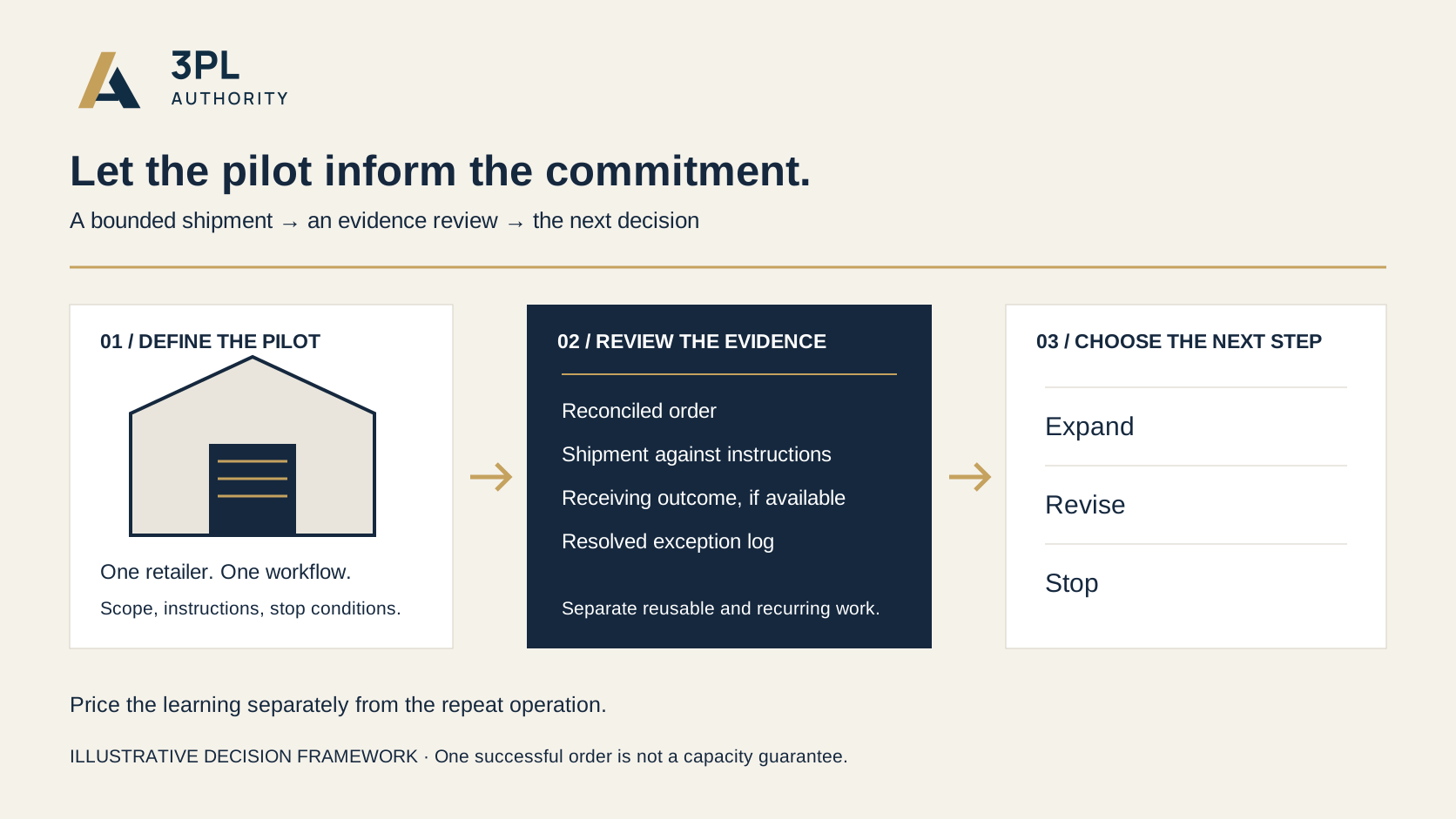
First, define the pilot boundary: retailer, purchase order, product configuration, destination and shipment window. Avoid a broad promise to support retail when only one workflow has been examined.
Second, define the evidence needed to expand. Our suggested evidence set is a reconciled order, a shipment matching the approved instructions, the receiving outcome when available, and a resolved exception log. Passing one order is evidence about that order. It cannot establish sustained peak capacity or readiness for every retailer.
Third, define the stop decision. Who can hold a shipment if its label or destination data disagrees with the buyer's instructions? What happens to remaining stock and unfinished setup if the pilot ends? Include those costs in the launch budget rather than treating exit as a distant problem.
Buy a repeatable result
Use the post-pilot review to separate reusable setup, recurring work and exception work. Ask the 3PL to explain any proposed change in price or staffing using the actual task record. Do not annualize a single smooth shipment into a performance guarantee.
A pilot is useful when it changes the next decision. If it leaves you with no clear record of what worked, no estimate of repeat cost and no practical way to stop, a low first-order price has bought very little learning.
Related reading
Sources
Research accessed October 24, 2026.
- https://www.costco.com/f/-/vendor-inquiries