
A busy quarter can conceal an expensive contract A seasonal brand can be large enough for a fulfillment provider in November and too small for the same commercial arrangement in February. That is a selection problem before it becomes an invoice problem. The right question is whether the agreement fits the shape of demand over its full term.
The U.S. Small Business Administration distinguishes costs that stay fixed over a period from costs that vary with volume in its break-even calculator. A monthly fulfillment floor creates a related modeling issue: additional orders may add nothing to a bill until eligible activity exceeds the floor. Our exercise below applies that idea to invented contracts; it is not an interpretation of any provider's terms.
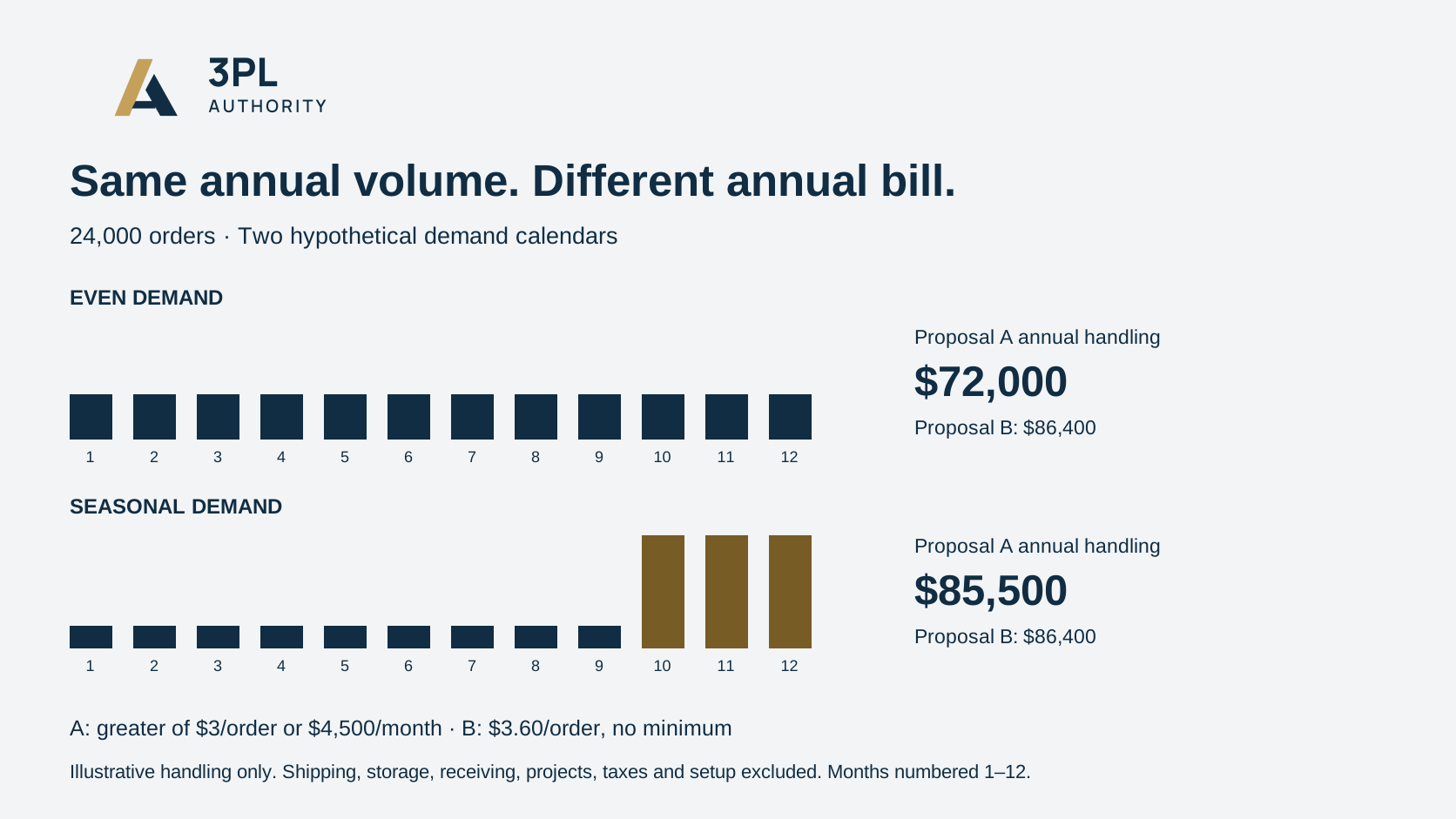
Two calendars, the same annual volume We constructed two twelve-month calendars with 24,000 orders each. The even calendar has 2,000 orders every month. The seasonal calendar has 1,000 in each of nine months and 5,000 in each of three months. This deliberately isolates timing rather than growth.
Hypothetical Proposal A charges the greater of $3 per order or $4,500 per month. Proposal B charges $3.60 per order without a minimum. For this exercise, both prices cover exactly the same narrowly defined handling service. Shipping, storage, receiving, projects, taxes and setup are excluded from both. These are modeling assumptions, not market prices.
| Demand calendar | A: annual modeled handling | B: annual modeled handling | Lower modeled bill |
|---|---|---|---|
| 2,000 orders every month | $72,000 | $86,400 | A by $14,400 |
| Nine quiet months, three busy months | $85,500 | $86,400 | A by $900 |
For the seasonal calendar, A costs nine times $4,500 plus three times $15,000. Its apparent $14,400 advantage nearly disappears without a single change in annual volume. An average-month comparison would have missed $13,500 of modeled expense.
Test the downside before negotiating the upside Now keep the three busy months at 5,000 orders but reduce each quiet month to 700. Annual orders fall to 21,300. A still costs $85,500 because every quiet month remains below its floor. B falls to $76,680, making B $8,820 lower for the modeled service.
This does not establish a provider winner. A might include useful capacity, better handling or services absent from B. Those benefits need their own evidence and scope. Nor does a minimum payment automatically reserve warehouse labor or guarantee a dispatch commitment. Ask what operational obligation the payment actually buys.
Give shortlisted providers a calendar to price Send each provider monthly orders, units per order, expected occupied space, inbound receipts and special projects. Ask for a completed twelve-month pricing worksheet rather than one attractive peak-month example. Include a lower-demand calendar that reflects a plausible commercial setback.
Resolve these questions in writing:
- Which charge categories count toward the minimum, and which are added afterward?
- Does the floor reset monthly, or can unused commitment carry forward?
- Do all facilities share a minimum, or does each have its own?
- Is a seasonal reduction actually offered, and when must it be requested?
- What happens during onboarding, closure or a partial month?
Do not assign favorable answers where the quote is silent. Keep those cells unresolved and obtain comparable terms before ranking the offers.
Decide on the service and the calendar together A practical selection review has two gates. First, confirm that the provider can support the busy-period workflow and service commitments. Then check whether the annual economics remain workable when the quiet months are genuinely quiet. A low headline handling rate is useful only after both gates pass.
Our calculation uses two synthetic calendars and one downside case. It excludes inventory financing, service failures and transition costs. Use the worksheet structure with actual quotes; do not reuse its dollar amounts as a budget.