
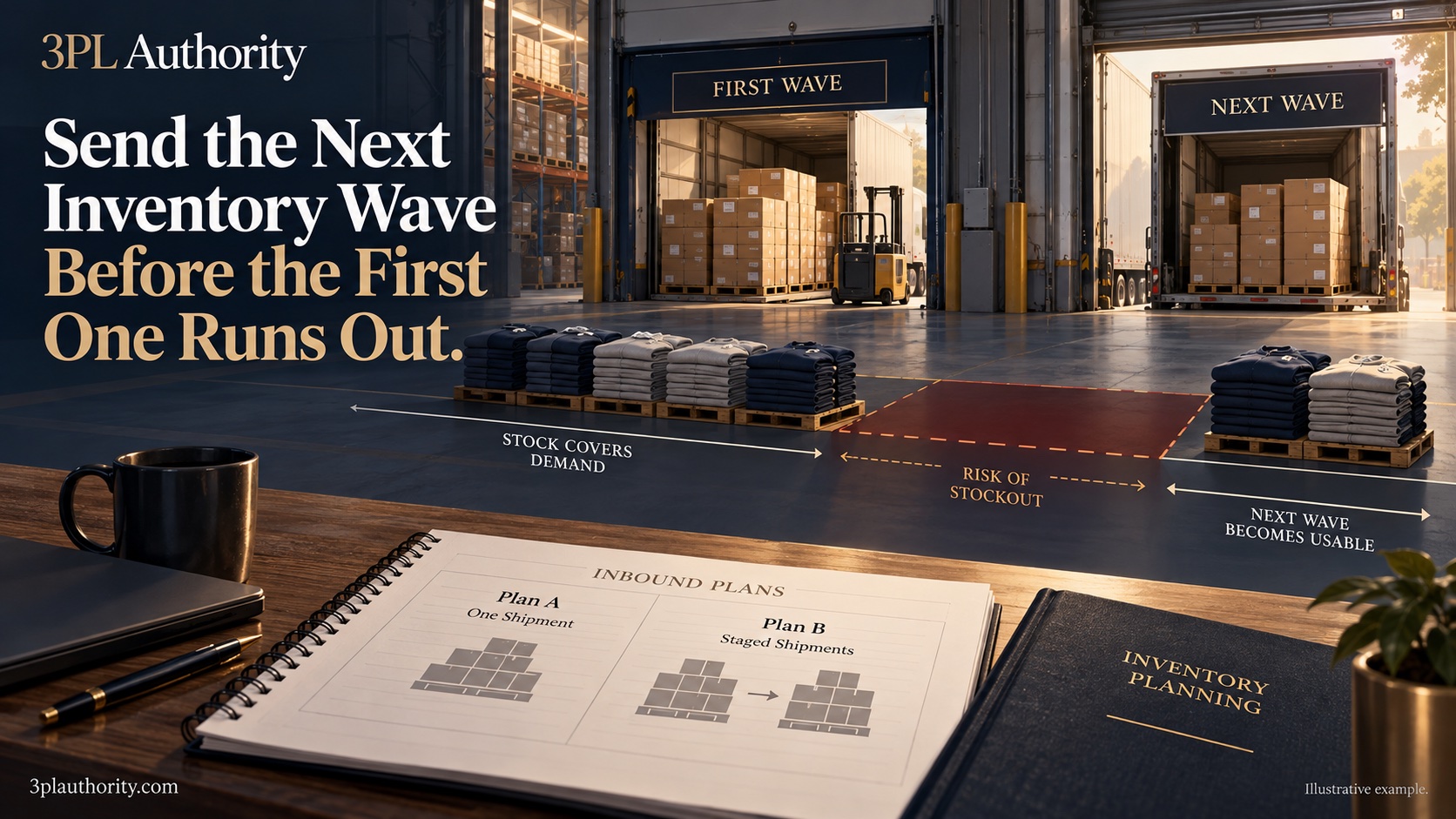
A smaller opening shipment creates a second decision
Sending a full season of stock to a new fulfillment warehouse ties the location decision to the inventory decision. A staged plan can keep some units elsewhere while the brand learns which products sell from the new location. But it also creates a replenishment deadline. The relevant deadline is when the next units can be picked, not when a truck is booked.
Ask a prospective 3PL to quote two concrete inbound plans: one opening shipment and a smaller opening shipment followed by replenishment. Keep the total units and product mix identical. Then compare the receiving appointments, handling charges, storage exposure and days of usable stock. This is a decision about the cost and reliability of replenishment, not simply whether the warehouse accepts smaller deliveries.
Model the day stock becomes usable
We calculated a deliberately simple scenario for one hypothetical SKU. Demand is exactly 100 units each day, there are no returns or damaged units, and new inventory becomes usable at the start of the stated day. These are planning assumptions, not a forecast or a measured warehouse result.
| Input or outcome | Staged plan |
|---|---|
| Total units to be placed over time | 2,400 |
| Opening usable inventory | 1,200 |
| Days covered by opening stock | 12 |
| Second wave | 1,200 |
| Planned availability of second wave | Start of day 9 |
| Opening stock remaining at that point | 400 |
The opening wave covers days 1 through 12. At the start of day 9, after eight days of consumption, 400 units remain. That is four days of nominal cover. If the second wave is not usable until the start of day 14, day 13 has no stock to serve demand. The example does not assume a backorder policy or assign a dollar cost to that interruption.
Moving inventory is not a single status. Shopify, for example, documents transfers between locations and external suppliers, full or partial receipt, and multiple shipments. Those capabilities support tracking a staged plan; they do not establish that a particular 3PL has completed inspection and put-away. Shopify transfer documentation.
Price the work that a second wave adds
Request separate amounts for the additional inbound movement, appointment or receiving minimum, inspection and put-away. Check whether storage savings use daily, peak or another billing basis. Keeping fewer units at the fulfillment site does not necessarily reduce the storage invoice by the same proportion.
Next, ask what could consume the four-day buffer. The answer should distinguish transit delay, receiving backlog, an incomplete shipment record and an inventory hold. A tracking delivery scan resolves only one of those questions. Ask the provider to name the event that turns each received unit into sellable stock and the evidence your team can see.
Set a replenishment trigger you can act on
Use a trigger based on usable units remaining and the full replenishment lead time. Include the time your team needs to approve the transfer, not just the carrier movement. Test higher daily demand and a partial second receipt before accepting the plan.
A staged approach is a candidate when the extra inbound work is affordable and the stock buffer survives plausible delays. A larger opening placement may be more suitable when replenishment is slow or uncertain. Neither choice follows from this one-SKU illustration alone. Ask the 3PL to repeat the exercise with your actual demand, receiving history and product restrictions before committing inventory.
Related reading
Sources
- https://help.shopify.com/en/manual/inventory-and-locations/inventory-transfers — accessed 2026-10-20