
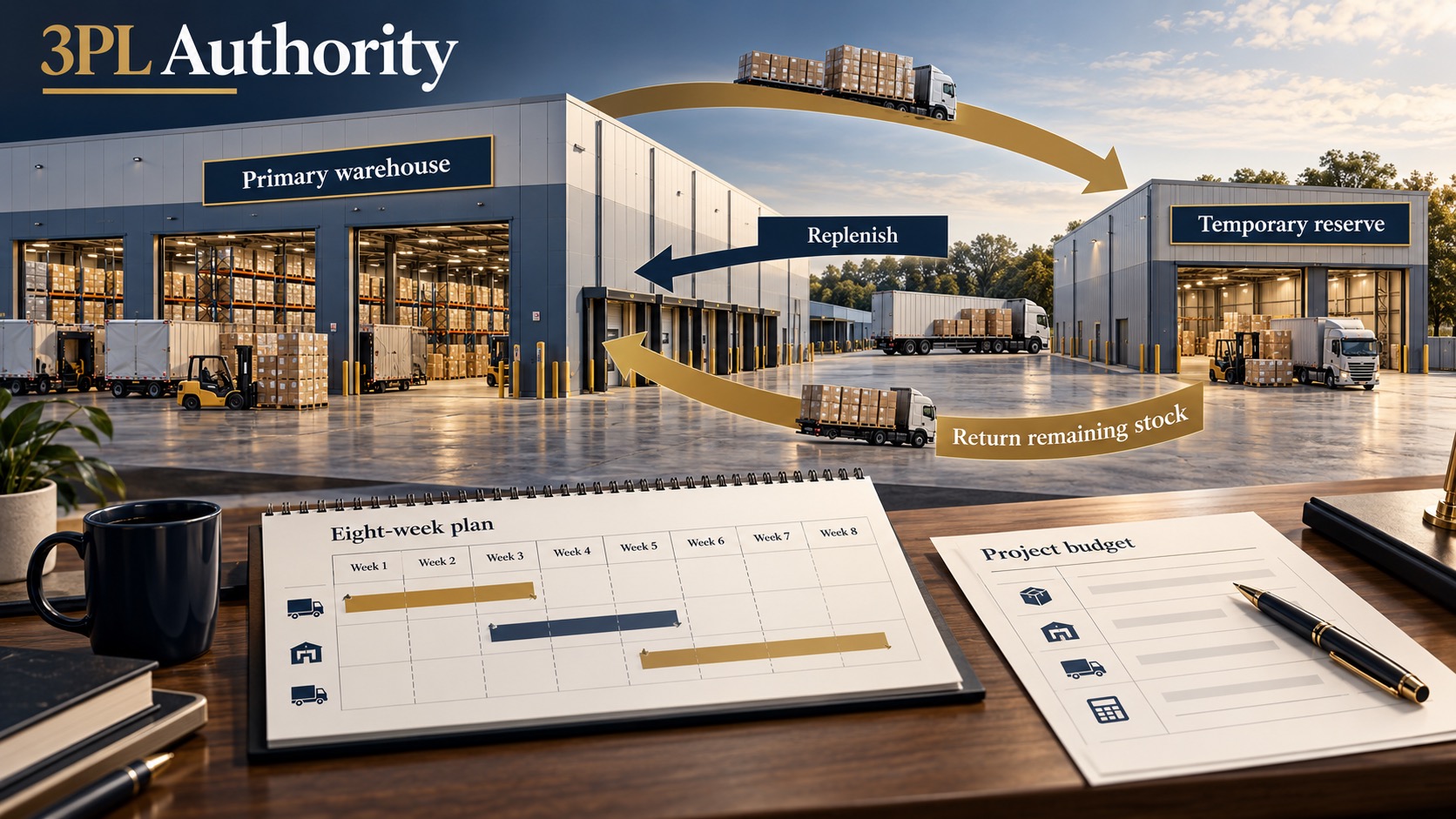
Give the overflow site an end date
A short storage shortage does not automatically justify another permanent fulfillment location. Before requesting proposals, define whether the outside warehouse will store reserve inventory, replenish the existing fulfillment operation, or ship customer orders itself. Those are different assignments. A cheap storage proposal cannot answer a customer-order fulfillment question without additional scope.
For a seasonal brand, a useful starting brief names the products, maximum units, expected weeks and final removal date. It also identifies the warehouse that remains responsible for everyday orders. This narrows the choice to providers that can execute the temporary job, rather than allowing an attractive location to become a long-term commitment by default.
Compare the whole temporary project
We calculated two illustrative eight-week storage projects for the same inventory. Neither provider exists; the figures are planning assumptions. Outbound customer fulfillment, taxes, insurance and inventory financing are excluded and would need separate treatment if they differ.
| Hypothetical project cost | Site A | Site B |
|---|---|---|
| Opening transport and receiving | $1,800 | $2,800 |
| Eight weeks of storage | $1,600 | $1,200 |
| Replenishment handling and transport | $2,400 | $1,600 |
| Final removal and receiving back home | $2,200 | $1,200 |
| Total | $8,000 | $6,800 |
Site B costs $1,000 more to open but $1,200 less overall under these assumptions. Its lower storage rate alone explains only $400 of the difference. The rest comes from moving stock during and after the project. That is why the exit belongs in the initial quote.
If the project extends by four weeks at the same hypothetical weekly storage rates, A adds $800 and B adds $600. This sensitivity calculation changes no other cost. It cannot predict extension availability, revised transport rates or a provider's minimum term.
Keep reserve stock separate from available stock
A reserve location needs an inventory record even when it never ships to shoppers. Shopify documents transfers between store locations and external locations. That provides a way to represent movement; it does not prove that a warehouse integration reports usable stock correctly. Shopify inventory transfers.
Ask how the provider distinguishes reserved, in-transit, received and releasable inventory. Specify who authorizes replenishment and how the receiving warehouse acknowledges it. A weekly spreadsheet might be sufficient for a small reserve operation if its timing and ownership meet the business need. A live integration is valuable only when the underlying movements are dependable.
Use three decision gates
First, confirm that reserve stock can be separated without starving daily fulfillment. Select the actual SKUs and quantities; do not assume every unit can move equally easily. Second, establish the replenishment service the primary warehouse needs, including appointments, shipment quantities and escalation when supply is late. Third, obtain a priced removal plan with a destination that has agreed to receive the remaining stock.
Use the same worksheet for a permanent expansion proposal, but extend its horizon and include the additional order-routing work. The temporary option wins only if it solves the temporary constraint at an acceptable total cost. If year-round demand requires another shipping operation, disguising that need as overflow merely postpones the real selection decision.
Related reading
Sources
Research accessed October 21, 2026.
- https://help.shopify.com/en/manual/inventory-and-locations/inventory-transfers