
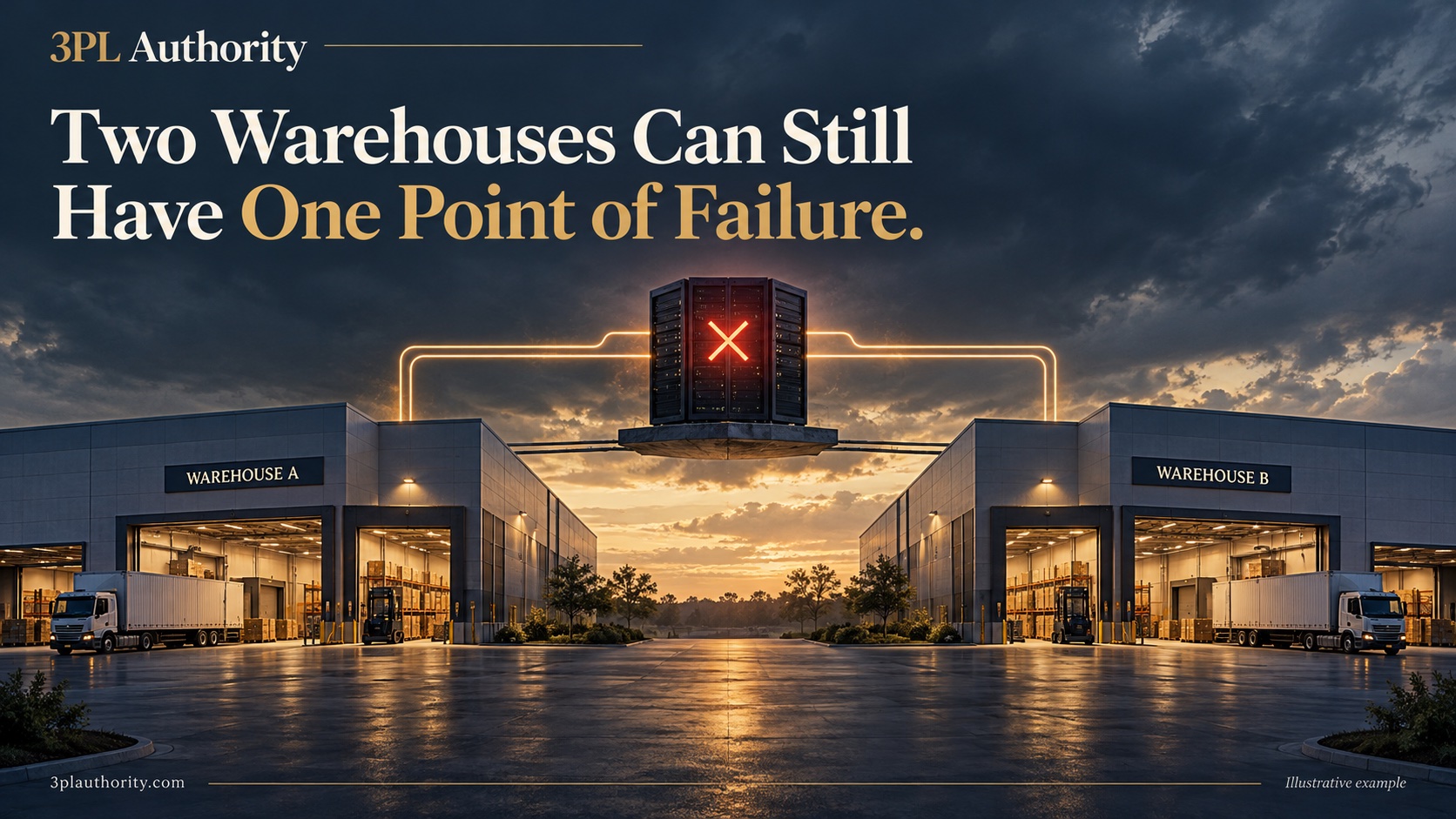
A second warehouse can improve reach without giving the business a second way to operate. If both buildings stop when one order connection fails, geographic separation has not solved that particular risk. Buyers should identify the failure they want to withstand before paying for redundancy.
FEMA’s supply-chain continuity training emphasizes dependencies and interdependencies, including nodes, transport and goods in transit. It is an emergency-management framework, not a ranking of commercial 3PL networks. The useful buyer application is to trace what both locations still share.
Start with a dependency map
List the steps needed to turn an accepted order into a carrier handoff: order intake, stock access, work authorization, picking, labeling and collection. For each step, ask what resource enables it and whether both buildings rely on the same resource.
A common system is not automatically a weakness. Shared systems can simplify normal operations. The question is whether the proposed recovery path still works when the shared component is unavailable, and what control prevents duplicate orders during recovery.
Compare three hypothetical outage cases
This original desk exercise tests three deliberately different disruptions. It does not estimate outage probabilities or describe an actual provider.
| Disruption | What a second building might offer | What still needs evidence |
|---|---|---|
| One building cannot operate | Another location for eligible work | Stock, people and authorized routing there |
| Shared order feed is unavailable | No automatic benefit from distance | An approved alternate intake and reconciliation process |
| Common carrier collection fails | Another dispatch point might help | A usable alternate collection or service arrangement |
The table explains why “two sites” should not receive one blanket resilience score. A solution can be effective for the first row and unproven for the other two. Ask the provider to describe the boundaries of its proposal rather than promise uninterrupted operations in every event.
Put capacity and inventory into the answer
Suppose a fictional business normally ships 1,000 orders daily from each of two warehouses. If one fails and the surviving location can handle 1,400 total orders, only 400 additional daily orders fit there. Across a two-day interruption, 1,200 orders remain beyond that stated capacity, assuming unchanged demand and no other constraints. Duplicating the address did not duplicate spare capacity.
That calculation is optimistic if required stock is missing or orders cannot be rerouted. Treat capacity, inventory and system readiness as separate gates. Do not add their percentages together to create a misleading readiness score.
Buy a defined recovery outcome
Ask the candidate to name the disruption covered, the work it can continue, the activation owner and the evidence expected from a rehearsal. Record dependencies that remain shared. Review any proposed fallback with the people who would actually operate it.
The selection decision is then clearer: pay for protection against a named business exposure, with known limits. A network map is useful evidence of location. It is not, by itself, evidence that an alternative operating path exists.
Related reading
Sources
- FEMA supply-chain continuity training — accessed 2026-10-19.