
A domestic address is not a complete expansion strategy
Moving inventory closer to U.S. customers can be a useful decision, but a warehouse proposal should begin with the orders that the new operation can actually serve. Website traffic, total overseas sales and a hoped-for conversion lift are different inputs. Treating them as one demand forecast can leave the new warehouse holding the wrong amount of stock.
Build the initial brief around products, channels and destinations that are ready for the proposed operation. Keep product eligibility, import arrangements and selling requirements as separate approval questions for the responsible specialists. A warehouse's willingness to receive a carton does not settle those questions.
Filter demand before choosing the inventory position
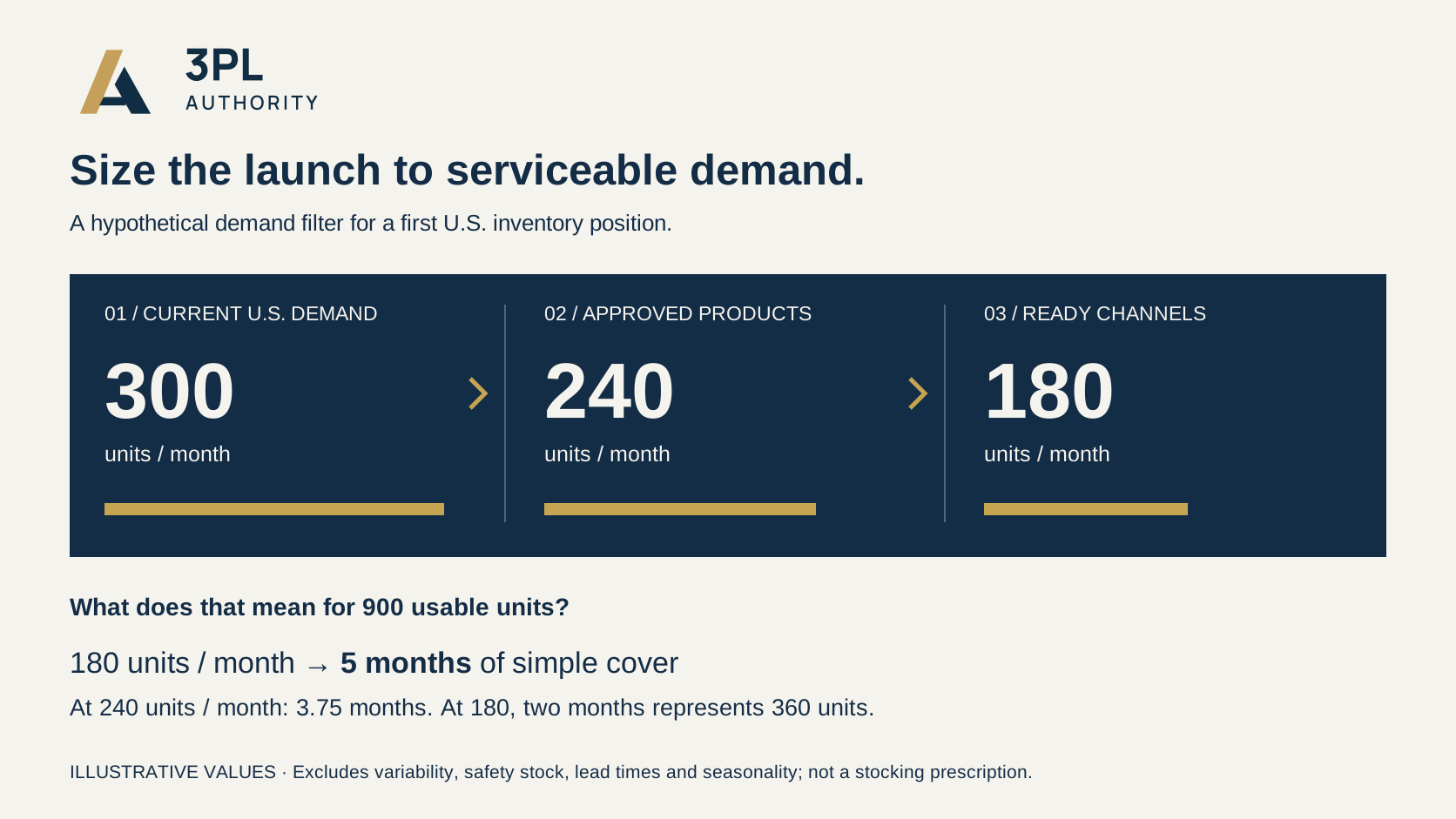
We constructed an illustrative three-stage filter for a brand considering its first U.S. stockholding location. These are invented monthly unit counts, not market research or a forecast.
| Stage | Units per month | Reason for the narrower count |
|---|---|---|
| All current U.S. customer demand | 300 | Starting observation assumed for the example |
| Products approved for the proposed launch scope | 240 | Excludes products outside that scope |
| Demand in channels ready to use the new warehouse | 180 | Excludes channels whose operating path is not ready |
The last row is the starting point for the launch-stock discussion. It should not be inflated to include future channels merely because a provider offers an integration for them. Equally, excluded demand is not permanently lost: it belongs in a later release plan with its own readiness evidence.
Use your own completed-order history and document the period, unit definition, cancellations and promotional events. A one-off wholesale purchase should not silently become recurring monthly demand. Ask whether the pattern persists outside the promotion that produced it.
Make the inventory exposure visible
In our example, placing 900 usable units against 180 eligible units per month represents five months of simple cover: 900 divided by 180. If eligible demand is instead 240 units, the same stock represents 3.75 months. A two-month starting position at the lower assumed rate would be 360 units.
This is a sensitivity check, not a replenishment prescription. It excludes variability, safety stock, inbound lead times, seasonality, product restrictions and stock already committed elsewhere. Add those inputs before setting an actual order quantity. The useful finding is that opening additional sales channels changes the stock calculation materially; it should be a documented event, not an assumption hidden in the quote.
Compare the operating commitment separately
Ask for a cost schedule that separates fees incurred simply by maintaining the operation from charges triggered by orders, receipts or projects. The SBA's break-even guidance distinguishes fixed, variable and mixed costs. That distinction helps structure the review; its calculator does not determine whether your specific warehouse expansion is worthwhile.
Price the low-demand case as well as the intended launch case. Include the brand's own work: stock planning, customer support, exception approvals and returns decisions. Identify what happens to unsold goods if the launch is delayed. Do not assume that a domestic warehouse removes international transportation or import costs from the wider supply chain.
Approve a bounded launch
Before shipping stock, require a named owner for four decisions: product and channel readiness, initial inventory, replenishment triggers and the pause or exit plan. Confirm how the warehouse reports stock by status and how orders are routed to it.
The strongest proposal need not cover every U.S. order on day one. A limited launch with visible assumptions can generate useful evidence while preserving options. Expand when the eligible demand and operating results support it, rather than treating the existence of a new warehouse as proof that the market is ready.
Related reading
Sources
- https://legacy.sba.gov/business-guide/plan-your-business/calculate-your-startup-costs/break-even-point — accessed 2026-10-26