
Price both sides of the warehouse
A delivery map tells you where a warehouse can send an order. It does not tell you what it costs to keep that warehouse stocked. When two locations can meet the required customer promise, compare the replenishment route before treating a lower parcel quote as the winner.
The Small Business Administration’s planning guidance separates fixed and variable costs when analyzing a business. Our location test applies that general distinction to an original, hypothetical fulfillment decision. It is a comparison of two cost alternatives, not a forecast of profit or a claim about a particular region.
Hold the service promise constant
Start with the same product, packaging, delivery requirements and customer destination file. Ask both candidates to price that file. Separately price movement from your actual supplier or inventory origin to each facility, including the receiving work included in the proposed scope.
If one candidate cannot meet a non-negotiable service requirement, a cheaper total does not repair that gap. Keep that candidate outside the cost comparison until the gap is resolved. Likewise, do not compare one delivered freight quote with another quote that stops at a terminal.
A location crossover, using invented numbers
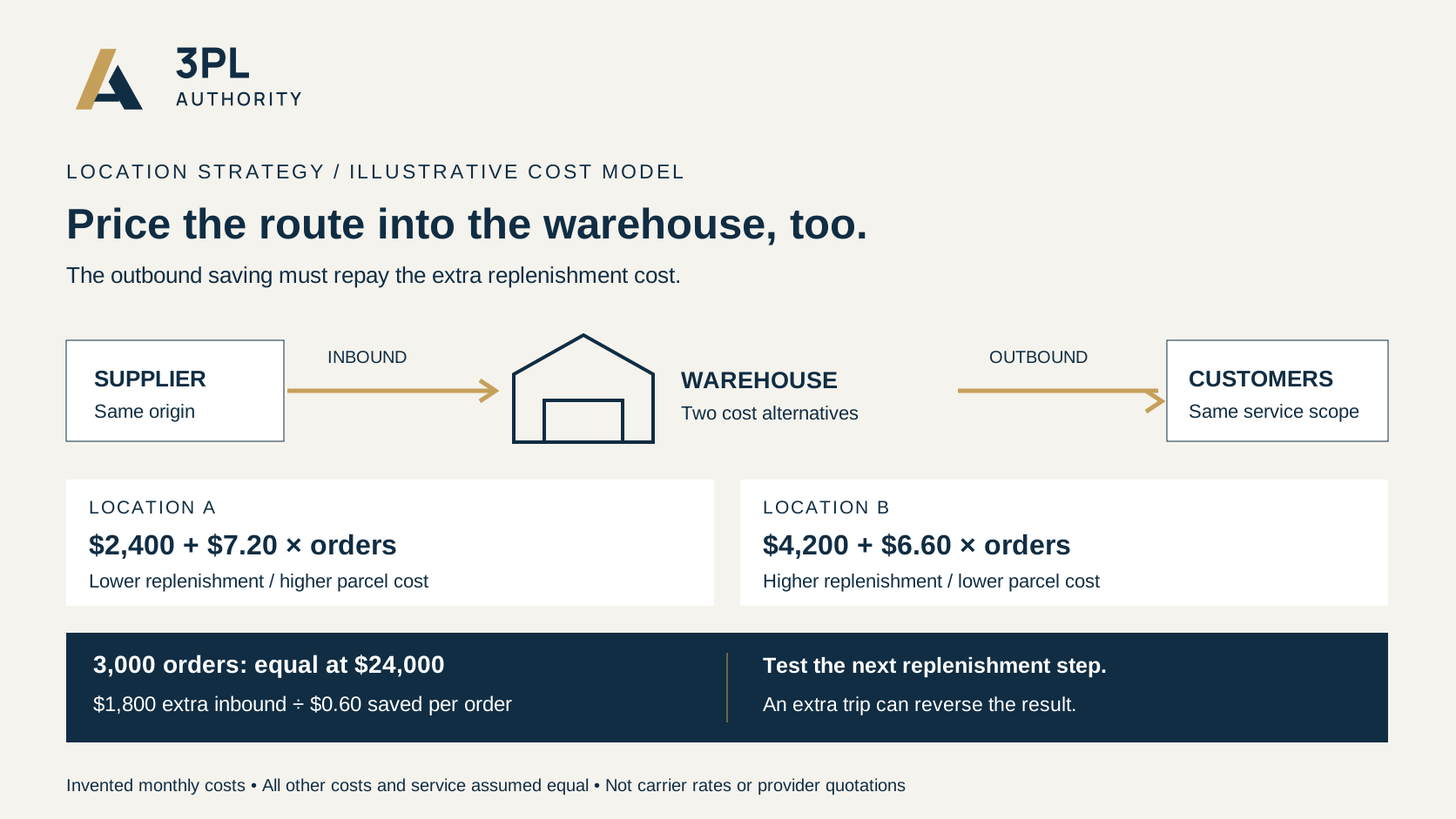
Assume Location A costs $2,400 per month to replenish and $7.20 per outbound order. Location B costs $4,200 to replenish and $6.60 per order. For this limited exercise, replenishment costs stay fixed across the displayed range. All other costs and service capabilities are assumed equal. These are invented values, not carrier rates or 3PL quotations.
| Monthly orders | A: inbound plus outbound | B: inbound plus outbound | Lower modeled total |
|---|---|---|---|
| 2,000 | $16,800 | $17,400 | A by $600 |
| 3,000 | $24,000 | $24,000 | Equal |
| 4,000 | $31,200 | $30,600 | B by $600 |
B saves $0.60 on each outbound order but adds $1,800 to replenishment. Dividing $1,800 by $0.60 gives a crossover at 3,000 orders. Below that point, the parcel advantage does not repay the additional inbound amount under these assumptions.
Now change one assumption. If B needs an extra $900 replenishment movement in the 4,000-order month while A’s replenishment stays unchanged, B’s total becomes $31,500. A is then lower by $300. This does not predict that B will need another movement. It shows why a capacity step belongs in the model instead of a smooth extrapolation.
Ask what changes the inbound bill
Give each candidate the same replenishment calendar, expected shipment sizes, supplier origins and receiving requirements. Record whether the quote includes appointments, unloading, pallet handling and any transfer before the stock reaches its final location. Treat an undisclosed charge as an open question, not zero.
Then ask what happens when a shipment is smaller, late or urgent. A monthly average can hide a second trip created by a purchase-order change. Model that event explicitly and identify who decides whether to consolidate or expedite. Do not add a fee twice if it is already included in a delivered quote.
Use a decision range rather than a single answer
The useful output is a range of volumes and replenishment patterns in which each location works. Replace our invented inputs with matched written quotes and your own order history, then test a low month, the operating plan and a replenishment disruption.
This desk calculation excludes storage, inventory financing, duties, returns, setup costs and service failures; it does not imply they are equal in a real decision. Add the differences that apply before making a commitment. Keep the location that works across your credible cases, or document the specific growth assumption on which the choice depends.
A lower shipping label is useful evidence. It becomes a location decision only after inventory can reach that warehouse at a cost and cadence the business can sustain.
Further reading
Sources
- https://www.sba.gov/counseling/plan-your-business/ — accessed 2026-10-31.